
They Were Here When The Nation Began
One Family’s Seven-Generation Journey Through 250 Years of American History
Published in observance of the 250th Anniversary of American Independence, 2026
by Dr. Terry M. Turner
Rockwall, Texas
The document was folded and yellowed at the edges, but the handwriting was still clear enough to read. It was a page from the minutes of the Horeb Baptist Church in Hancock County, Georgia, dated November 9, 1850. Halfway down the page, in careful script, a clerk had recorded the following: “received by experience a colored woman named Lucy who was the servant of Sister Morris, was baptized.”1 I sat in the silence of my study and read those words again. Lucy. My second great-grandmother. Born into slavery around 1810. She was never meant to be remembered. And there, in a church’s minute book, written by someone else, was her name.
That moment of discovery launched more than two decades of primary-source research gathered into my upcoming book When Grace Flows Backward: Embracing Our Ancestors. In the summer of 2026, as the United States prepares to celebrate the 250th anniversary of its founding, I find myself with something unusual to bring to that celebration. It is a documented, end-noted seven-generation family history that stretches from my birth in Guthrie, Oklahoma, in 1957, all the way back to 1784, the year the American Republic was being established. In addition, 1784 is the year my fourth great-grandmother, Nancy, was brought from North Carolina to Georgia.
My family was here when this nation began. They did not come by choice. They were not invited to the celebration. Their names were not recorded in the founding documents. But they built the buildings, cleared the land, planted the cotton, bore the children, and held the faith that sustained them across seven generations of American history. This article is their anniversary tribute.
The Woman at the Beginning: Nancy, 1784

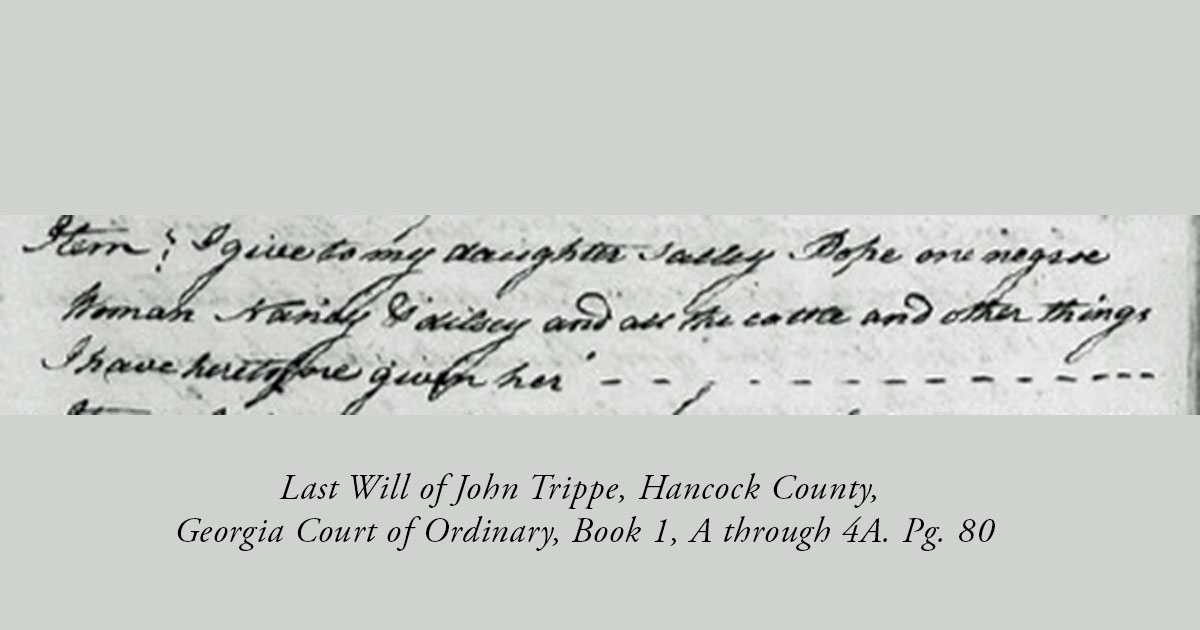
Figure 1794 Last Will of John Trippe, Hancock County, Georgia Court of Ordinary, Book 1, A through 4A. Pg. 80
The oldest ancestor I can document by name is a woman I know only as Nancy. She was brought from North Carolina to Hancock County, Georgia, in 1784, the same year the United States was newly independent, and James Madison was drafting what would become the Constitution. She appears in a probate inventory and will in the estate of John Trippe, who died in 1794.2 Two sentences in two documents. Without those two sentences, every generation that followed her disappears from the American record entirely.
Nancy’s daughter, Dilsey, was born around 1790. Dilsey’s daughter, Lucy, was born around 1810. Lucy’s son, Warren, was born around 1839 and first appears in the historical record in January 1843, at age four, on the courthouse steps in Sparta, Georgia, being sold at a sheriff’s auction to satisfy a dead man’s debts.3 The system of slavery, which the founders of this nation built into its economic and legal architecture, had taken everything from Warren’s family by the time he was old enough to stand. And yet they survived. And yet we are here. “They were meant to have no identity, no name that calls us to recognize they existed. Therefore, I have used this book to write the nameless into existence.”
The Road to Texas: A Forced Migration, 1853
In 1853, when Warren Turner was approximately fourteen years old, he was carried from Hancock County, Georgia, to Ellis County, Texas, by the Neel/Moss slaveholding family.4 The journey covered more than 800 miles and crossed five states. Warren was not asked because he had no choice. He was property under the law of the United States of America, and he went where the law permitted his owners to take him.
Warren arrived in Texas with dozens of other enslaved people who shared the surnames of Hancock County slaveholding families: Biggins, Neel, Moss, Latimer, Gonder, and Stokes.5 These were not coincidences. They were a community, however broken. The people who had been enslaved together in Georgia found themselves enslaved together in Texas and building a new plantation economy on soil that had barely been cleared.
Twelve years would pass before Warren was freed on June 19, 1865. He was nearly twenty-six years old and had never owned anything. He had never been permitted to sign a contract, marry legally, or testify in court. Warren stepped into freedom with nothing but the clothes on his back and the faith in his chest.
Freedom and the Building of a Life: Texas and Oklahoma, 1865–1909
What Warren Turner built after emancipation is one of the most remarkable passages in this entire family history. On February 6, 1869, he married Elvira Davis in Ellis County, Texas. This was one of the first legally recognized African American marriages in that county after emancipation.6 Together they had seven children. They farmed. They tithed. They voted Republican in every election they could reach.
Then they moved to Oklahoma Territory, where Warren eventually accumulated between 80 and 300 acres of land in Logan County. It was there that he built a church, served as a county delegate to the Republican Party, and was recognized in the Oklahoma press in 1906 as a man worthy of imitation.7 The newspaper article from the Benevolent Association meeting that year praised him as a productive landowner, a farmer of substance, a contributor to the nation’s wealth.8 Here stood a formerly enslaved man, praised in an American newspaper as a pillar of his community, forty-one years after Juneteenth.
Warren Turner died in April 1909.9 His wife, Elvira, outlived him by more than a decade, raising grandchildren in her seventies without complaint. She was a Juneteenth recipient, a matriarch, and a woman the family knew as extraordinary even when they did not know her story.
The Baptist Connection: Jesse Mercer and the Moral Wound at the Center
No genealogical article about this family and this anniversary can avoid the most unsettling discovery in the research. The Reverend Jesse Mercer, one of the most celebrated figures in Baptist history—the man whose endowment established Mercer University in Macon, Georgia,10 held legal power of attorney over six of my ancestors for seventeen years.11 His personal family Bible contains the birth records of seventeen enslaved people he personally owned. Their names were recorded alongside the births of his own children as if the enslaved were livestock of equal standing.12
Mercer was a contemporary of the founding generation. He was born in 1769, five years before the first Continental Congress. He lived through the Revolution, the Constitutional Convention, the Missouri Compromise, and the Indian Removal. He built one of the most influential Baptist institutions in the American South. And he kept human beings in chains while preaching John 8:34-36: “Whoever commits sin is a slave of sin. And a slave does not abide in the house forever, but a son abides forever. Therefore, if the Son makes you free, you shall be free indeed.”
At the 250th anniversary of this nation, his story is part of the story. So is Lucy’s. So is Nancy’s. The honest celebration of American history requires holding both.
What the Research Teaches: Breaking the 1870 Wall
For genealogists reading this article, I want to offer the practical heart of what twenty years of research has taught me. The 1870 wall, the point at which most African American genealogies go cold because the records of enslaved people were systematically withheld, destroyed, or never created, is real. But it is not impenetrable.
The documentary trail does not begin with the enslaved people. It begins with the people who owned them. Their wills, their estate inventories, their probate records, their church minute books, their prenuptial agreements, their sheriff’s auction notices, and their family Bibles all contain the names of the people they enslaved. Lucy appears in a church minute book.13 Nancy appears in a probate inventory.14 Warren appears in a sheriff’s auction notice.3 The system that denied them their own records left traces of them in the records of the people who held power over their lives.
DNA evidence has added a dimension to this research that no previous generation of African American genealogists had access to. It confirmed connections to the Gonder, Latimer, and Moss families of Hancock County that the paper trail could only suggest. The research methods I developed over twenty years are gathered in the Appendix of When Grace Flows Backward and serve as a practical guide for other African American researchers pursuing their own ancestors before the 1870 wall.
Seven Generations, 250 Years
The 250th anniversary of American independence falls in the summer of 2026. Here is what those 250 years look like for one African American family:
- 1784: Nancy arrives in Georgia from North Carolina.
- 1790: Dilsey, Nancy’s daughter, is born.
- 1810: Lucy, Dilsey’s daughter, is born.
- 1839: Warren, Lucy’s son, is born.
- 1843: Warren appears on a courthouse auction block, age four.
- 1853: Warren is carried from Georgia to Texas.
- 1865: Warren receives his freedom at Juneteenth.
- 1869: Warren and Elvira marry in Ellis County, Texas.
- 1890s: Warren and Elvira move to Logan County, Oklahoma.
- 1906: Warren was recognized in the Oklahoma press as a productive farmer.
- 1909: Warren Turner dies in Logan County, Oklahoma.
- 1957: Terry M. Turner is born in Guthrie, Oklahoma.
- 2026: When Grace Flows Backward is published.
Seven generations. Two hundred and forty-two years from Nancy’s arrival to this publication. The American Republic was four years old when Nancy came to Georgia. It is 250 years old today. Nancy’s descendants are still here.
A Trustworthy Anniversary
I am a patriot. I have preached in American pulpits for forty-seven years. I believe in the promises of this Republic. And I believe that the most honest way to celebrate 250 years of American history is to insist that the full history be told, including the history of the people this Republic refused to count as people for its first eighty-nine years.
When the architects of the American Republic wrote “all men are created equal” in 1776, Nancy was a child in North Carolina. She would be brought to Georgia eight years later. She would never vote. She would never own land. She would never sign a contract. She would be recorded in a probate inventory between a cow and a plow.
And yet the faith Nancy carried was passed to Dilsey, who passed it to Lucy, who passed it to Warren, who passed it to his children, and who passed it to me. It is the same faith that has sustained this Republic through every crisis it has faced. The enslaved people of this nation built more of America than they have ever been given credit for. They cleared the land, raised the buildings, planted the crops, and sang the hymns. And when freedom came, they stayed. They farmed. They voted. They built churches. They educated their children. They did not leave.15 That, too, is what 250 years of American history looks like.
________
About the Author
Dr. Terry M. Turner is a retired Southern Baptist minister and genealogical researcher from Rockwall, Texas. He served in denominational leadership for thirty-two years and retired in 2023. When Grace Flows Backward: Embracing Our Ancestors documents seven generations of his paternal family over 173 years and across five states, supported by 293 endnotes and a comprehensive methodological appendix for African American genealogical research before 1870. He is also the author of God’s Amazing Grace: Reconciling Four Centuries of African American Marriages and Families (2018).
Endnotes
1. Horeb Church (Hancock, Georgia), Church Minute Book, 1792–1916, November 9, 1850. Microfilmed by the Georgia Department of Archives and History. https://www.familysearch.org/en/search/catalog/koha:279280
2. Trippe, John, Last Will and Testament, General Index 1793–1900, Vol. A-4A, 1794–1807, p. 19–22. “Georgia Probate Records, 1742–1990,” database with images, FamilySearch. https://www.familysearch.org/ark:/61903/3:1:3QSQ-G93L-5X5W?view=fullText
3. Southern recorder. (Milledgeville, Ga.) 1820-1872, Feb.7, 1843, Image 3, Georgia Historical Newspaper. Georgia’s Virtual Library, Galileo, An Initiative of the University of Georgia. Retrieved Nov. 29, 2020. https://gahistoricnewspapers.galileo.usg.edu/lccn/sn82016415/1843-02-07/ed-1/seq-4/#date1=01%2F01%2F1843¬text=&date2=12%2F31%2F1843&words=&searchType=advanced&sequence=0&lccn=sn82016415&index=0&proxdistance=5&rows=12&ortext=&proxtext=&andtext=&page=1.
4. Claiborne Moss Interview, Federal Writers’ Project: Slave Narrative Project, Vol. 2, Arkansas, Part 5, McClendon–Prayer. 1936. Manuscript Division, Library of Congress.
5. Campbell, Randolph B. An Empire for Slavery: The Peculiar Institution in Texas, 1821–1865. Baton Rouge: LSU Press. Kindle Edition.
6. Ellis County, Texas, County Court Clerk. Marriages, Vol. B–D, p. 1–153, 1857–1879. Freedmen’s Marriage Records, 1869. Item 2.
7. Turner, Warren. The Oklahoma Guide (Seward News), Guthrie, Okla., Vol. 16, No. 13, Ed. 1, Thursday, August 30, 1906. Gateway to Oklahoma History. https://gateway.okhistory.org/ark:/67531/metadc275399
8. The Oklahoma Safeguard, Vol. 13, No. 27, Ed. 1, Thursday, August 2, 1906. Benevolent Association Meeting, Logan County, Oklahoma.
9. Warren Turner, General Inventory and Appraisement, Logan County Probate File No. 1807 (Archived). Logan County Court Clerk, Guthrie, Oklahoma.
10. Mallary, C. D. Memoirs of Elder Jesse Mercer. New York: Printed by John Gray, 1844. P. 208.
11. John and Mary Bishop Relinquish Trustees Mercer and Battle, Hancock County, Georgia. “Hancock, Georgia, United States Records,” images, FamilySearch. https://www.familysearch.org/ark:/61903/3:1:3Q9M-C95Y-L39M-N?view=fullText
12. Jesse Mercer, Georgia Bible Records. Compiled by Jennette Austin. Baltimore: Genealogical Publishing Co., 1985. P. 433. And Ancestry.com https://www.ancestry.com/imageviewer/collections/49169/images/FLHG_GeorigaBibleRec-0455?usePUB=true&_phsrc=LLj7362&pId=41976
13. Horeb Church (Hancock, Georgia), Church Minute Book, 1792–1916. July 13, 1844–November 12, 1853. William H. Stokes, Pastor (1844).
14. John Trippe, “Georgia, Headright and Bounty Land Records, 1783–1909,” database with images, FamilySearch. https://familysearch.org/ark:/61903/3:1:3QSQ-G9BL-YBN3
15. Turner, Terry M. When Grace Flows Backward: Embracing Our Ancestors. Rockwall, Texas, 2026. Closing Reflection, p. 250.