Jewish Special Interest Group
The Jewish Genealogical Interest Group’s mission is to assist anyone to research their actual (or suspected) Jewish ancestral lines.
The Jewish Genealogical Interest Group’s mission is to assist anyone to research their actual (or suspected) Jewish ancestral lines.
Join genealogist Elizabeth Swanay O'Neal of The Family Heart for an exploration of the free genealogy resources available through lineage societies that have spent more than 125 years preserving family histories, records, and research. From the online databases and digitized applications of the Daughters of the American Revolution to pioneer rolls, military ancestor lists, and other valuable records, this presentation will highlight the surprising tools available to every researcher — no membership required. Learn where to find these resources, how to use them effectively and how they can help you uncover new clues about your own family history.
This exhibit highlights rare books, pamphlets, and documents that illuminate the intellectual origins of American independence, alongside the library’s copy of the Declaration of Independence - one of only 26 surviving Dunlap Broadsides printed on July 4, 1776.
A Declaration Celebration is an America250 exhibit opening reception featuring a public reading of the Declaration of Independence by members of the Sarah Cockrell Chapter, NSDAR, and a keynote address by Dr. Pearl Ponce, Director of the George W. Bush Presidential Library and Museum. Guests will be among the first to experience the return of the Dunlap Broadside of the Declaration of Independence to its permanent home at the Dallas Public Library following its historic display at the Hall of State during the FIFA Fan Festival.
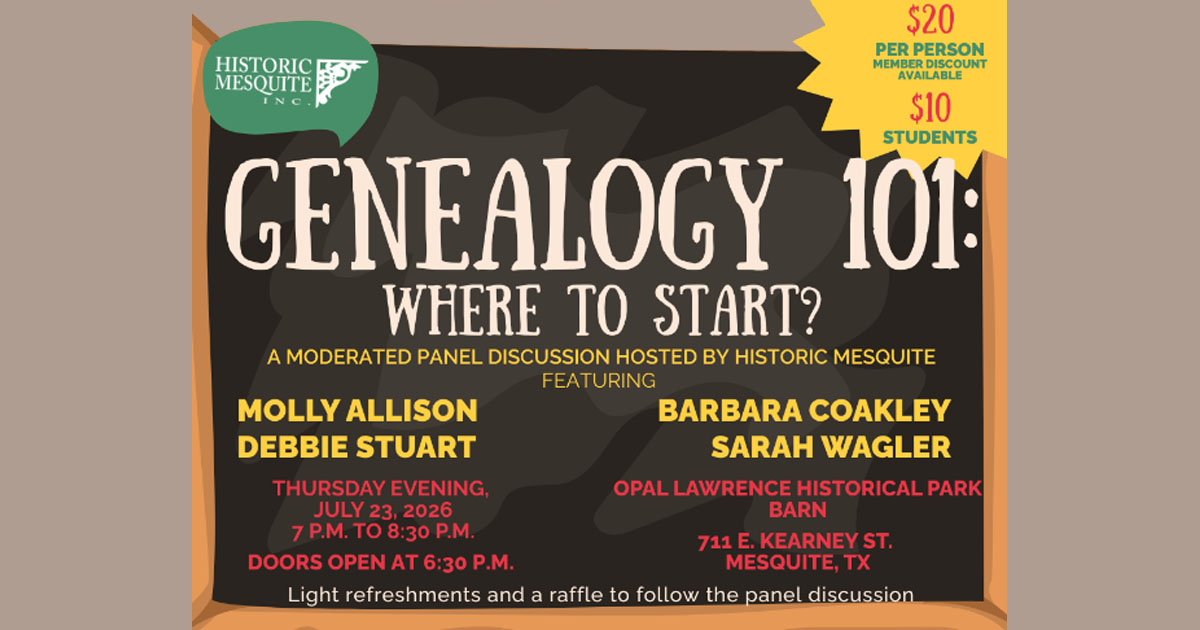
A moderated panel discussion hosted by Historic Mesquite.
During Vivid-Pix Memory Station Open Hours, you can scan and restore photographs, record the stories behind them, and create a personalized video that combines your images with audio recordings. Share family memories in your own voice, preserve the stories behind treasured photographs, and create a digital keepsake to pass down to future generations.
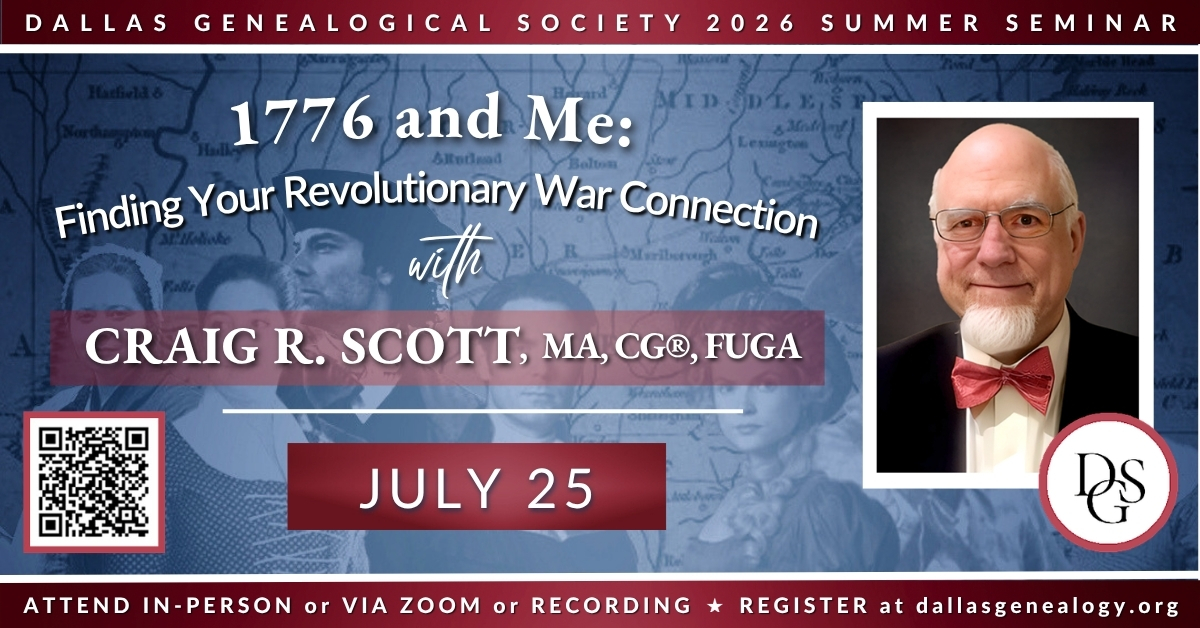
In recognition of our country’s 250th anniversary, we have invited Revolutionary War expert genealogist Craig R. Scott, CG, FUGA to come to Dallas and walk us down the paths we need to follow to find the details of our patriot ancestors’ service. Discover the impact the fight for American independence had on our forebears’ lives.
Tina Beaird presents "Play Ball!! Researching Your Political Ancestors."
In July’s selection, we turn to a vivid work of narrative history that brings the turbulent summer of 1776 into sharp focus. Moving between Philadelphia, New York City, and London, the book traces the precarious path toward independence through the perspectives of political leaders, soldiers, and ordinary citizens. By weaving together battlefield realities with the high-stakes debates of the Continental Congress, this selection highlights the uncertainty, risk, and contingency at the nation’s founding—inviting readers to reconsider the Revolution not as an inevitable triumph, but as a fragile and deeply human moment in history.
During Vivid-Pix Memory Station Open Hours, you can scan and restore photographs, record the stories behind them, and create a personalized video that combines your images with audio recordings. Share family memories in your own voice, preserve the stories behind treasured photographs, and create a digital keepsake to pass down to future generations.
Discover one of the most powerful—and often overlooked—tools in modern genealogy research. FamilySearch's Full-Text Search uses advanced AI technology to search the handwritten text within millions of digitized historical records, helping researchers uncover names, places and stories that traditional indexes may have missed.
During Vivid-Pix Memory Station Open Hours, you can scan and restore photographs, record the stories behind them, and create a personalized video that combines your images with audio recordings. Share family memories in your own voice, preserve the stories behind treasured photographs, and create a digital keepsake to pass down to future generations.
The Best Practices SIG is for genealogists who want to learn advanced methodology skills and techniques. The SIG is putting on a regular study group in addition to the formal Best Practices SIG meeting. This is for folks to come and work together, talk about genealogy and answer questions.
There is no set agenda, just time to spend together!
During Vivid-Pix Memory Station Open Hours, you can scan and restore photographs, record the stories behind them, and create a personalized video that combines your images with audio recordings. Share family memories in your own voice, preserve the stories behind treasured photographs, and create a digital keepsake to pass down to future generations.
Discover how Canva can help you transform genealogy research into engaging visual stories. Whether you're creating family history keepsakes, promoting genealogy society events, designing reunion materials or presenting research findings, Canva offers easy-to-use tools for every skill level. This program introduces practical ways genealogists can use Canva to organize, present and share their work.
The Jewish Genealogical Interest Group’s mission is to assist anyone to research their actual (or suspected) Jewish ancestral lines.
During Vivid-Pix Memory Station Open Hours, you can scan and restore photographs, record the stories behind them, and create a personalized video that combines your images with audio recordings. Share family memories in your own voice, preserve the stories behind treasured photographs, and create a digital keepsake to pass down to future generations.
The Best Practices SIG is for genealogists who want to learn advanced methodology skills and techniques.
Sara Cochran presents "Uncover your Scottish Roots."
Help Make Dallas History Searchable from Home! Join the Dallas Public Library's Remote Volunteer Transcription Program and help unlock historic records for researchers, genealogists, homeowners and historians. Volunteers can work from anywhere, on their own schedule, transcribing historical documents into searchable text. No commute is required after the orientation—just a computer, internet access and an interest in preserving local history.